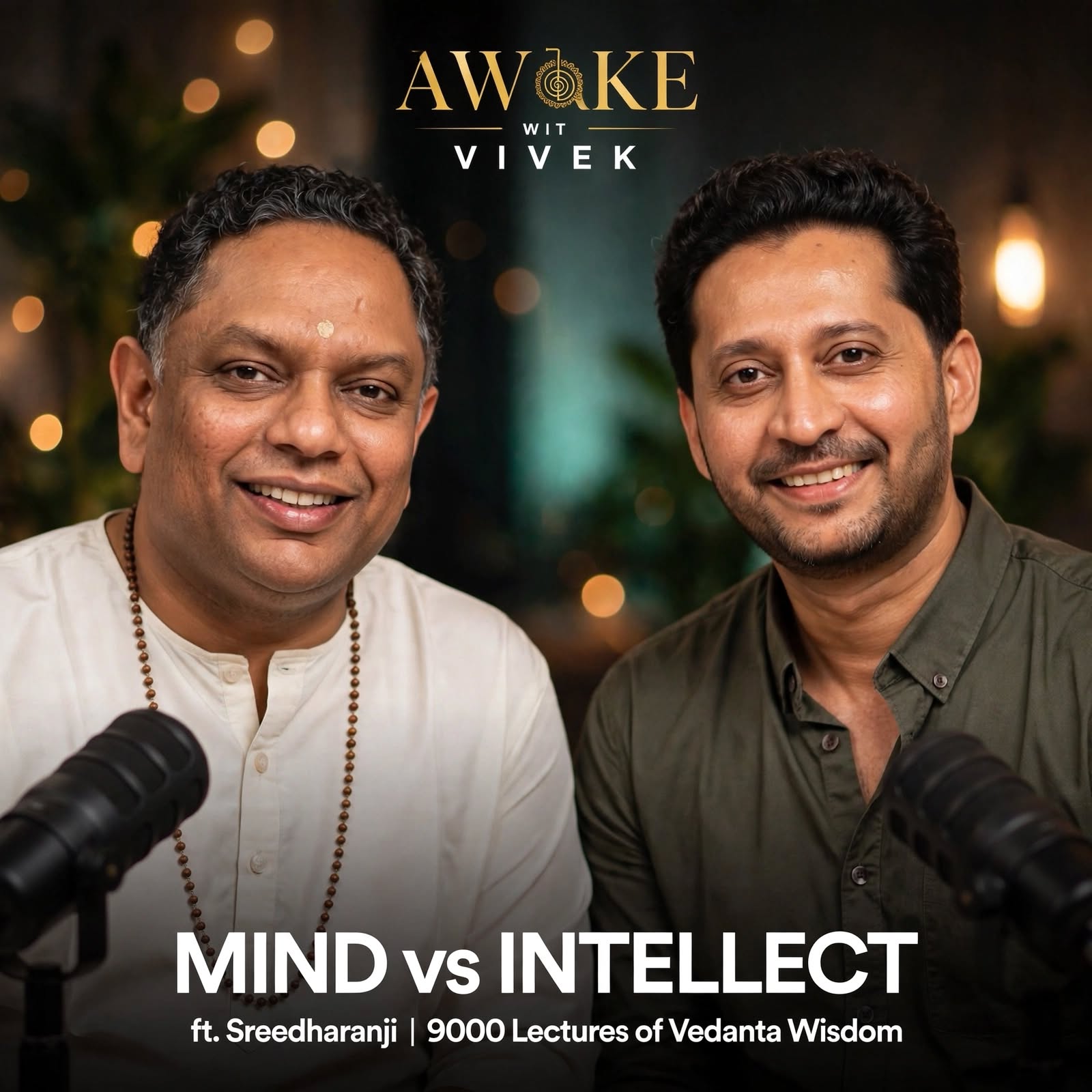
Episode Transcript
[00:00:00] Speaker A: Vedanta is a Sanskrit word taken from two Sanskrit words, Veda and Anta. Veda, literal meaning is knowledge. Anta means end, the end of knowledge.
The common misconception is people think there's no end to knowledge. You can go on and on. AI is here. And what will be the next one? Heaven and hell. I wish there were geographical locations.
Then Jeff Bezos or Elon Musk could have got massive lands there. The test of human evolution is at the end of the day, when you hit the pillow in 10 seconds, you should fall off to sleep.
[00:00:40] Speaker B: If you could explain to us what is the difference between mind and intellect.
[00:00:45] Speaker A: There's this youngster asked Swami Ramathirta, when will I be free?
To which he said, when the I ceases to be.
[00:00:54] Speaker B: I think to get this knowledge, it'll take a lifetime as well.
Welcome to Awake with Vivek. The space where we explore higher consciousness, clarity, and the wisdom that transforms modern living. Today we are honored to host a guiding light in the realm of Vedanta and self realization. Sridharanji, the founder of mind and intellect. For over 28 years, Sridharanji has dedicated his life to studying, researching and sharing the ancient philosophy of Vedanta, translating timeless truths into practical tools for our everyday lives.
Having delivered more than 9,000 lectures worldwide, his teachings have touched seekers across cultures, ages and backgrounds. His mission is simple yet profound, to awaken emotional purity, sharpen clarity of thought, and guide us toward inner strength, balance, and lasting fulfillment. Sridharanji, welcome to Awake with Vivek.
[00:01:54] Speaker A: Thank you, Vivek. It's a great title, Awake with Vivek.
I'm glad and happy to be a part of your podcast and appreciate this opportunity.
[00:02:08] Speaker B: Thank you, Sridharanji. Let's start with asking you about understanding the meaning of the word Vedanta. And then we'll understand the philosophy, right?
[00:02:19] Speaker A: Vedanta is a Sanskrit word taken from two Sanskrit words, Veda and Anta. Veda literal meaning is knowledge. Anta means end. So Vedanta, as two words put together, means the end of knowledge or the culmination of wisdom. And the common misconception is people think there's no end to knowledge.
You can go on and on, AI is here, and what will be the next one? And I said, you need a SI to deal with AI, the spiritual intelligence, to use AI in a constructive manner. So there's no end to knowledge. But the glory of Vedanta is it leads to your true nature.
There's a great French philosopher who made a beautiful statement.
He says, we are not human beings going through a spiritual experience.
We are spiritual beings going through a human experience. And there is also another beautiful statement. They say the purpose of spirituality.
It leads you to a place where you have always been and to know it for the first time.
It's a journey from where you are now to a place where you have always been and to know it for the first time. That's what Vedanta helps you. Anyone and everyone, irrespective of nationality, age or preferential locations.
It is possible.
It gives you the potential which leads you to your true nature eventually.
And I'm sure you're also inspired by Aham Brahmasmi. I am that indivisible Brahman. Now. Just words, but experientially, when you go through it, Aham Brahmasmi, there's a genuine smile and contentment with it. It's not. It is that, oh, you're proclaiming yourself.
It's a statement of experience.
Aham Brahmasmi, I'm not this assemblage of body, mind and intellect. Sharira, Manas and Buddhi, they all belong to me. See now these are all words and oh lovely concept to reflect upon. But Vedanta helps you to get to that state and experience what my Guru used to say as uninterrupted happiness, 24 by 7 uninterrupted happen, I mean unbroken bliss.
See, he also used to say, most of us experience happiness or pleasure.
But it is like having a chocolate with the wrapper.
You have the chocolate. Imagine a person, he is very fond of chocolates. He sees a box full of chocolates, instantly takes up two and starts having it.
There is chocolate sweetness, but there is also the wrapper. You spit it out. So what Vedanta says is it opens it and gives you only that which has to be consumed. The little labyrinth Vedanta is found in the end portion of Vedas. Vedas has various portions, ritualistic portions. There is Puranics, there is stories, there is chants and there is Upanishads, which is the end portion of Vedas, the spiritual knowledge. The spiritual knowledge, that's the Vedas is a elaborate text. There are four Vedas and in each Vedas there is the chants, there is rituals, there is stories and there is Upanishads which contains the essence of Vedanta. So that's where the real wisdom is given out. I mean everywhere there's wisdom, but very concise, cryptic.
Aham Brahmasmi is there in the operations.
So in that end portion of Vedas so it is Vedanta in simple terms or in the modern context introduces yourself to yourself.
[00:06:26] Speaker B: Beautiful.
[00:06:27] Speaker A: So that's Vedanta. Till such time you are only aware of certain aspects of you. We are all aware.
If you ask somebody, they are aware of certain things. Not completely, not in a sense.
[00:06:40] Speaker B: But it's only at the surface level. It's not at the deeper subtle level and even the very subtle level.
[00:06:46] Speaker A: To go into the deeper level you need to be intense.
So most people are in the superficial, caught up in their own. What Adi Shankara calls as Samsara.
Samsar is not just wife. Samsar is the entire worldly entanglements which keeps us grounded in the world or rooted in the world.
So nothing wrong with it, they are fine. But there are certain people who are awake to the realities. What is this? Who, who am I? What am I constituted of? How do. How should I contact the world? Or what should I take up to? I mean, should I follow a herd instinct? Or can I? Is there a Swadharma in me? What is it I should take up to?
[00:07:26] Speaker B: I think that's the beauty of it. Once you know who am I? Once you realize that, you will not be able to express it in words. That's what I've heard. Is that true?
[00:07:36] Speaker A: Yes, yes and no. I mean, it is difficult expression words with people who don't understand. It's like you are in a room, there are 10 people and you are awake. Now you know that you are awake. You know who is sleeping.
Another person gets up, is awake. So he knows that we both are awake.
But a person who is in deep sleep, they don't know.
I mean, it's like, it's difficult. How do you communicate with the person in sleep? It's like that.
[00:08:10] Speaker B: It's like that.
[00:08:11] Speaker A: But another person who's awake.
[00:08:12] Speaker B: Very well said.
[00:08:13] Speaker A: So a person who's another person who's awake, he knows and he's not another bragging, I'm awake, I'm awake.
He knows that you're awake.
He could be a chef and you could be an accountant.
There is no, you know, it is no barrier. No barrier, nothing. I'm just saying it is.
He likes matcha, I like cappuccino and you like cappuccino. But nobody is bragging, you know what, I'm awake. Imagine if somebody says, you know I'm awake. You say, what happened to you?
[00:08:48] Speaker B: What happened to you?
[00:08:49] Speaker A: But this question with reference to people who are in a room, eight people are sleeping, two are awake.
You know you are awake. So a person, how can you communicate with the person who's asleep if you say it says just mind your own business here. I want to.
[00:09:08] Speaker B: This is the idea as well. I'm on this path where, you know, we're trying to awaken people to higher consciousness and, you know, more clarity. Sridharanji, I would like to know that, you know, quality of life is within us rather than, you know, finding it outside in luxuries and material world.
And it also matters how much we put our mind into what and how much we do it.
Would you agree on this Pa, that quality of life is within us and not outside?
[00:09:34] Speaker A: Absolutely. I mean, I agree with it completely. But also I would say the quality of life is within us, but the standard of life is outside of us.
In fact, you need a combination of both.
You know, it is a, it's like we are in a podcast studio.
You need an air conditioner, you need certain lights. The standard of life also is required, but that doesn't determine the quality of life, meaning that's not going to have an impact on quality of conversation. We could be sitting in a parking lot and have a very in depth conversation or you could be sitting in a Himalayas and have a very gossipy conversation.
So quality of life is within us. Absolutely.
They say your mind in its own place can make a hell out of a heaven or a heaven out of a hell.
So heaven and hell, I wish they were geographical locations.
Then Jeff Bezos or Elon Musk would have got massive, massive lands there.
Heaven and hell are state of mind within you.
So the quality of life is within us but you know, the standard of life is outside of us.
What Vedanta says is you need a good combination of both.
See, standard of living at the cost of quality of living is useless.
You could be driving, I mean you could be driving a, a Ferrari and you feel like crashing and destroying yourself because the quality of life is very poor.
You could be in a public transport and feel like you own the place.
You are so peaceful and then looking at, there's a smile, there's a joy.
So quality of life is important, but standard of life is also important. Meaning it is that combination.
Combination is conducive.
It's much better to suffer in a, in a, in a villa than in a, in a shared accommodation.
So you know, at least you have a nice couch and you know, rather than sitting in a crowded, in a shared accommodation now and feel sad about it. So that's therefore I am with you 100%.
Quality of life is within us.
That's the entire purpose of Vedanta.
But standard of life is also there. And you're living with dua. No, no, no. I would say.
I would say 75, 25.
I mean 100% quality of life standard of living is conducive. That's what I'm saying. You could travel in public transport or you could travel in a Bentley.
But if there's a potential of traveling in a Bentley, why not?
And this elusive combination of a quality of living and standard of living, that's what Vedanta highlights.
You need both.
See. Then more people will take up to it.
Imagine your quality of life is there, but there's no standard of living.
Then how many can you inspire, motivate.
But if you imagine you do a work and you absolutely enjoy doing it and you are paying dwell for it, how it is rather than it is. You have a beautiful villa and you sleep very well.
My guru used to vehemently highlight. The test of human evolution is at the end of the day when you hit the pillow in 10 seconds you should fall off to sleep.
If you bargain, he says two minutes or five minutes. Five minutes. You should be off to sleep like a baby, like a child.
What is the point in having a Mattress which is $10,000 and you're rolling in the bed?
So that beautiful combination, the grandeur of Vedanta, the wisdom of Vedanta is you'll get both.
You may not need it, but it's like you may have a Rolls Royce and your friend family comes in. Oh, they are very excited. And the friend's son tells you uncle, can I use your. I mean can I use your Rolls Royce for half a day?
Of course. Go.
You tell your driver, please take them around for the whole day. And you're taking a public transport. You're bindas, you're peaceful.
How will I go now? No such thing.
Because the quality of living is very pure and intense.
The standard of living you can manage, but both should be there.
Peace and productivity, wealth and happiness that should be there. Not one at the cost of the other.
What is the point of having all the wealth and you are in pieces within.
What is the point?
You are in a small town, very quiet, very peaceful. Within no productivity.
You need the delusive combination of productivity and peace.
[00:14:55] Speaker B: Amazing. In fact, wanted to ask you that you have started mind and intellect. Since it's been a long time here in Dubai, if you could explain to us what is the difference between mind and intellect.
[00:15:09] Speaker A: Mind and intellect in Sanskrit words is sharira's body. Mind. Manas is mind. Buddhi is intellect. All of us have it. Irrespective of the nationality or the geographical location. Everyone has these three equipments. Physical body, mind and intellect. Physical body follows the dictates of the mind and intellect.
If you don't want to go to work, you'll find all the reasons.
[00:15:39] Speaker B: Push yourself.
[00:15:39] Speaker A: Push your. It's like there was this.
The mother waking up her son and says Son, it's time, we have to go to school. And the son was annoyed. I don't want to go to school. Why are you troubling me? And I said give me two reasons. You have to go to school.
And then the mother said look here, the school starts at 8:30am and it is almost 8:15.
So you have to go. That's the number one reason. Number two, you are the principal of the school.
[00:16:12] Speaker B: God bless the mother. I mean you know. Amazing.
[00:16:14] Speaker A: No, I am just saying the mind finds ways to avoid things.
So the mind is the source of your emotions and feelings. Good and bad, positive and negative. The mind is where the emotions of gratitude, compassion, love, kindness, anger, jealousy, fear.
All these things arise from the mind.
And that is the nature of the mind. And the mind is an endless source of these emotions.
And when I say it can produce positive and negative provided the direction is given.
And then another aspect of the mind is your likes and dislikes.
You like matcha and you don't like green tea.
There is a statement, right? They say have green tea you lose weight. And I mean I met one tea plantation owner. He said yes, absolutely you can lose weight. Provided you climb entire the mountain, pluck the green tea leaves and go to your home and heat it. Then there's a possible losing weight by having green tea alone and all. You can't lose weight. Just so likes and dislikes.
You like certain things. You like waking up in the morning and going for a jog or yoga. You dislike sleeping late. I wish more people have this habit. Waking up early and going to bed early.
So you like.
If you are in Europe, you like summer.
If you are in Dubai, you like winter.
And you say some people say I love summer. How can you like.
[00:18:09] Speaker B: So I am one of them.
[00:18:11] Speaker A: You are one of them. You like summer except even me, you don't need a steam or sauna. You go out and all toxins come out.
So likes and dislikes.
You know we are nothing. Each one of us is nothing but likes and dislikes. You know, you like black color and you don't like yellow color. Every aspect and another is impulses, another aspect of the mind.
Somebody tells you, hey, what happened? You put on weight.
I do power yoga and this person comes and tells me, I put on weight. How dare the impulse that comes in. So each one of us, our mind is that feelings and emotions, positive and negative, likes and dislikes and impulses. Your mind, my mind, everybody's mind is that the intellect is your source of reasoning, understanding, clarity, analysis, logic, constructive thinking. That's reasoning. That's why Buddhi, even the Bhagavad Gita, Buddhi Nasha, protest Shati.
That's clarity. Buddhi is class. We have this mind and intellect.
[00:19:24] Speaker B: So there is a stark difference between.
[00:19:26] Speaker A: There's a stark. Both are thoughts, mind is thoughts, intellect, also thoughts. Mind is an indiscriminate thought. It can flow anywhere.
You could be sitting here and be thinking of Himalayas. Correct. Better.
Instead of thinking of Malibu or Las Vegas, Miami, you know, you could be sitting here and thinking of Himalayas or, you know, it could be. It is. You could be sitting in Malibu and thinking of Las Vegas. No, I'm just saying it is. The mind has no direction. There's no. It can go anywhere and anywhere, everywhere. Intellect gives you a direction to your thoughts. Imagine if I'm sitting here and my thoughts goes to, you know, Himalayas.
I say, look here, Himalay is a great place. But now I have this podcast. There's a question asked by Vivek and he's trying to awake everyone else. I'm going to sleep in this way. So I am consciously that when I use my intellect, I get the thoughts to a certain direction.
And as a result, I can answer your question if the mind is there. If I am functioning on the mind, you may ask a question and my answer will be completely different. I say, what is he answering?
So intellect, to use intellect, it requires certain discipline, certain effort, and it gives a direction to your thinking. Therefore, there is constructive thought process. There is a sequence of reasoning you give. So that is, everyone has it.
Mind by design. We use it from.
We learn to laugh and cry from a young age.
So we gravitate to the mind very easily.
But to the intellect, it has to be developed, it has to be nourished, it has to be looked into.
[00:21:24] Speaker B: I think great understanding with this. The difference between mind and intellect and where we are actually bringing a lot of clarity in our life, is where we use our intellect correct? Is there a way to sharpen the intellect? Or is there a way that people, as a beginner, practice something so that they first of all understand the difference and start using it in a right way.
[00:21:43] Speaker A: In a way, most people are using the intellect, but only in a minuscule, limited manner. See, when I say most people use the intellect in a particular field, a person could be in medicine, they are using the intellect to gain the intelligence. In the field of medicine, a person could be using their intellect in the field of civil engineering.
So their thinking, their analysis, understanding, all that pertains to a particular field of activity alone.
So that's the reason intelligence helps you up to a point, but that's not going to help you to control the desires of the mind, the cravings of the mind or the insecurities.
So a person could be a great surgeon, but it could be an alcoholic.
A person could be a fantastic civil engineer, but could have sleep issues.
So most people are using the intellect, but in minuscule ways, in a limited manner. But the right ways of using the intellect is especially. That's why I say take up a thought, reflect on it, understand it, get inspired by it, and inspire implemented.
See, it is without implementation, there's nothing.
It is in Sanskrit, we call it shravana, manana and nithidhyasana. Shravana is you listen.
Listening is different from hearing.
I'm sure all married people know when the spouse is talking.
15 minutes they're talking, and finally she asks, what's your choice? What do you suggest we should do in a. Can you repeat it?
I've been talking to you for 10 minutes. You didn't hear a word.
Sound waves are going through, but nothing is.
So here, listening is hearing intently.
So shravana is. You are listening without your preconceived notion to develop the intellect, shravana.
And then manana is having heard you have the data, you reflect on it, you try to understand.
Does it make sense? Do I understand it?
How do I correlate with my life experiences? You are reflecting on it in a certain way and then you could be inspired. Hey, this sounds very nice.
If I integrate this in my life, I'll be a better person. Now, nitidhyasana meditation says you are integrating it in your life, making it a living experience. And now it is no more a thought, it's a part of your DNA.
So that is how intellect gets strengthened. Like, it's like a muscle.
Mind is like a blood flow, it flows. But intellect is a muscle. You got to develop it. You may have a great gymnasium. The trainer is getting better because he is coming and training.
And you say, not that one, do something else. His muscles are getting Trained. But it's like, you may have a library of books, or you may have a great masters, or you could be living in a fantastic holy city, but nothing will happen to you.
There was a lady who went up to a great spiritual master and she shared her experiences. I've gone through the entire Bhagavad Gita.
And the master asked her, has the Bhagavad Gita gone through you?
The Bhagavad Gita should bore a hole in your system.
She thought she will emphasize now, I've gone through entire 18 chapters of the Gita.
I've read your commentary, all that.
And she thought, oh, fantastic, but great.
His answer is, has the Bhagavad Gita gone through you?
Every pore of your system should reverberate with the wisdom of the scriptures. So that's what I mean. So therefore, Shravan, Manan and Nithidhyasana.
So this is the way. So I would suggest whatever books inspires you. Ideally, I would suggest take the fundamentals. In fact, I would recommend my guru's book. Not because my guru, it's a digest of Vedanta, a book called the Vedanta Treatise, Complete works of Vedanta, from the Basics to the ultimate.
Where you take. You read one page, you try to understand.
Yeah. No, you don't need. I tried to do this And I read 90 pages. And I told my guru, I thought I'm going to impress him. He said, sridharan, this is not Harry Potter.
90 pages.
Just read one pages. In fact, two, three paragraphs is enough.
[00:26:35] Speaker B: Understand?
[00:26:37] Speaker A: Read five, 10 minutes, reflect 20 minutes, whatever time you know, five minutes, 10 minutes. Because you got to, it has to. You got to digest it. Anything subtler takes time and effort.
So intellect is only developed once you develop it. It's a part of you. It's like once you learn how to drive well, it's a part of you. You can even see you can drive a Nissan, what do you call Sunny or a Kia Picanto also very well. And if you don't know driving, you can drive a Bentley in a haphazard manner.
It's not the car, it is how you drive. Once you know any car, you can drive gracefully. It's like that. Once you develop the intellect, it's there for you. And that's why they say in the Gita, in a beautiful statement in chapter six, Lord Krishna says, udharet Atmanatmana.
He says, you have to lift yourself by yourself.
Who says? Lord Krishna says. He says. He doesn't say I can't help you. He says you have to lift yourself by yourself. You are your greatest friend. And you could be your worst enemy.
When things are not going, you say life is terrible.
You could be your worst enemy.
And it is you are your greatest friend. So once you develop the intellect, then it's a challenge to be looked into. It's not a problem to suffer the moment you say people are victims of the mind. Oh, there's a problem.
By saying that itself, the situation looks much bigger than you.
[00:28:19] Speaker B: Too much to handle.
[00:28:20] Speaker A: It's a challenge to be looked into. Meaning you bring in the intellect to how to deal with it. So the Manas and Buddhi are two great gifts given by nature, divinity to each one of us.
How we use it is our potential.
So therefore it says, I've given you the potential.
So how you make use of it is your effort.
That's why they say no pain, no gain.
There was this young Sadhak meditator who's been meditating for a long period of time. And all that he wanted was to win a lottery.
And finally the so called divinity appeared before him.
And then he was.
First he was pleased and then he was annoyed. I have been meditating for such a long time. You come after so late, he said. To which the voice told the young man, I want to help you win the lottery. But son, you have to buy a lottery ticket.
You have not yet bought a lottery ticket. What do you expect me to do? It's like that.
[00:29:37] Speaker B: It's a guiding force.
[00:29:38] Speaker A: Effort, effort, effort.
Life is determined by consistent effort, effort.
So that's what intellect helps you to do. It keeps you in the process. That's when a journey is far greater, much better than the destination. You got to enjoy the journey. Intellect helps you to absolutely enjoy the journey.
[00:30:00] Speaker B: You did mention about Shravana, Manana and Aditya. And this happens, you know, in school days or college days when we study and you know, after the exam we forget everything. And then what happens? We come into a working professional life and then we say okay, now I'll retire and then I'll start studying the spiritual scriptures. The study of Vedanta, let's say. But why do you think the study of Vedanta or the scriptures are very, very important in today's day and time and for working professionals or for young
[00:30:28] Speaker A: adults, I mean it's a good question. It's a pertinent question.
Most people, you know, I would say almost 8 out of 10 think we Vedanta is a post retirement pastime.
When you have retired, you know, one foot in the grave, one foot above and you have nothing else to do. Nobody at home talks to you. And then, you know, now it's time for Vedanta.
My question is where the Bhagavad Gita expounds Vedantic wisdom. But where was that given?
In the battlefield.
In the battlefield. It was not given. Somewhere in the deep caves of Himalayas in the battlefield unto whom it was given not to a 90 year old person, to a young dynamic warrior, a soldier, a leader.
So still, even though it is evident, we miss it completely. So there is another story that was a great archer.
He used to win in all the championship.
And there was another archer who came to know that. There is this archer, he all his, you know, tournaments, he has a bullseye, he wins 10 out of 10. And this other archer was, who was reasonably good, was very keen and he went up to the other, you know, the archers who always shoots bullseye. He went up to him and said, everybody talks about you that you are in a 10 out of 10. You hit bullseye. And I'm only done in a seven. Six. Seven out of 10 times I hit, that's a maximum. I could never progress beyond that. Can you teach me your inputs? That'll be valuable. He said, I can tell you, but you should not share with others.
And with only one to one. He said, oh yeah. And then he came and then the archer who shoots 10 out of 10 he said the problem with you is you draw the circle and then shoot.
I shoot and then draw the circle smart.
So it's like I shoot and then draw the circle.
Similarly in Vivek, most people live their life and want to know how to live life.
It is as absurd as the archer shooting. And then ah, now I've got.
You got to learn.
You got to learn when you're young because life is meant for living, not for a.
After retirement anyway, nothing else to do. See it is. So it's a mindset shift which should come up but slowly it's happening. You find a lot of people at the helm of affairs or even in the political scenario. The sense of spiritual intelligence is cropping up. It is becoming a go to tool for everybody to make better choices.
So eventually that will become mainstream.
Twenty years ago when I took up to it and it's been almost 30 years in this path, they used to say what happened to you? Are you depressed?
Is there a relationship failure? What happened to you? Are you, are you okay? Why this you can take up when you are 70, 75 and nobody understood it. So now they are understanding. You find it's almost mainstream now.
Mainstream. So it is. So therefore that effort has to be there. See, first is a mindset change. This is something which will help me and it is not a post retirement pastime.
It is a technique for dynamic living for the young people so that all this will come to play provided people understand the different roles they have in life.
And all that I have developed is intelligence in a particular role. But I need a strong intellect in other roles of life to make better choices.
That's why I said people are slowly understanding that you could be very successful at work. But if you have failed at the home front, you're still a failure. And your success at work cannot be a reason for the failure in other roles.
So now they have understood that the world doesn't need any more one role wonders. They mess up the world. You need a holistic wonder.
You are productive at work, you're a reasonably good, I would say friend, you're a loving spouse, you are an inspiring parent, you are a good sibling.
You are a conscious social person. So you need all that for that. You need Vedanta, you need the spiritual alignment. So the awakening is coming up in a much better way. It was not like what it used to be before, but it is slowly coming up and I'm sure over a period of time it will become mainstream.
If you observe the number of people visiting holy places have shot up in the last 20 years.
There is what you call Bhajan jamming happening, right?
[00:35:48] Speaker B: Yeah, it's happening a lot.
[00:35:49] Speaker A: And then it is a podcast where a lot of in a spiritual knowledge is shared. So it's no more, I mean a niche areas or you know, it is, it's mainstream, but it will take some more time because.
But youngsters are waking up to is. And I wish more youngsters take up to it because it is something which help them, you know, all through their life.
It's not something which you know fades away over a period of time. This is something which is here to stay to the extent you get exposed, aligned knowledge, see, to the extent you imbibe, to that extent your life becomes better.
So you will slowly find most people taking up to it in their own ways.
It is whatever the faith is, let them follow it, let them take the best out of it.
So eventually it's all value systems. In the spiritual Vedanta, it gives you value, high value systems and as a result you are aligned with the purest of values. And how can you get toppled See, it is essential so that resilience comes in with spiritual wisdom, world may knock you down 10 times. 11th time you wake up, you stand up and you are pursuing it.
So that's the grandeur of this wisdom.
So I am confident that more people will take up because it is like oxygen.
If anybody says I can do without oxygen, this knowledge is like oxygen.
To breathe and live peacefully, you need oxygen. And to breathe and live life peacefully, you need this wisdom.
And that's why they say it is God helps to help themselves.
And therefore in more of this aspect, working on yourself. The great Swami Vikananda mentioned, right? Conquer your mind, you'll conquer the world.
Fall a prey to your mind, you become a victim of the world.
So it's like you see the portrait of Swam Vikanda.
He looks like he can handle 10,000 warriors. Like the command, the confidence he oozes. In his picture there's a photograph, the Hindu monk of India. There's a very famous portrait of Swam Vikananda. You look at him, there's great Swami Ramathirta. He says his portrait. He says, O kings and commanders, my fanciful toys. Here is a deluge of fire line clear my boys. He says, it is this here. O kings and commander, my fanciful toys.
Here is a deluge of fire line clear my boys.
I mean, he goes on, it's not out of ego Ahambrahmasmi in a very powerful manner.
[00:39:07] Speaker B: You know, as we speak about Vedanta, if people are new to the subject, new to the understanding, what would be the recommended way to pursue this knowledge?
[00:39:20] Speaker A: I would suggest first allocate some time.
Ideally early part of the day, allocate a place for it.
Because most people, when they take up a book or anything, they sit in the dining table, in the sofa, lying down or in the bed or before going to bed.
First is have a dedicated time and a place.
See why? Because the mind gets used to it.
Then it's something serious. It's like you want to discuss a very important.
I mean, if there's an important meeting, you'll go to a conference room. Less disturbance. You tell the secretary for the next one hour, don't disturb us because you need that time and effort. So similarly, if you are able to, first is that time, ideally early part of the day. And then a place a desk which is meant for.
And then take up a book which you think is going to help you.
Or if you attended the lectures, make some notes, reflect over it more is understanding.
When you try to understand, you may have questions that's when you will seek answers. Hey, I can understand up to this. Beyond this I am not able to understand.
So then what happens? That's most people in the morning they do body stretching. It's mind stretching mind. You know, once you start then ah, this is. You know, a lot of people know gratitude is important, but how many are grateful? I know gratitude, you may read. I know gratitude is important, but how do I inculcate this value in my life?
I'm not able to still inculcate. You may think why there's another statement. I mean I often emphatically highlight this. Express your gratitude to one and all, but don't expect gratitude from anyone.
Express your gratitude. I'm grateful for the opportunity. I don't even met you before first time. And you know, you had that faith in me that this guy may speak some sense.
[00:41:38] Speaker B: Lot of sense.
[00:41:38] Speaker A: I'm resonating.
[00:41:39] Speaker B: I'm in fact you know, finding myself completely immersed in the thank you.
[00:41:45] Speaker A: I'm grateful for that. See, expressing gratitude for all that source and.
But if I expect gratitude, I mean I'm sure you're grateful, but I'm just saying certain people now you have heard that statement.
How do I make it my own? I mean, how do I understand it? Then there comes inspiration, then implementation. So I would suggest people, the viewers and listeners, take up a book which you think is going to help you. Whatever book, ideally scriptures, I would suggest, you know, I would suggest the Vedanta treatise or written by Swami Parthasarathi. It is there on all the platforms. But any other whatever book, I'm not saying that is a. It is a great book. Take up a book on life, on your true nature and then read, understand whatever inspires you. See how you can implement it and slowly make all these things a part of your life.
I may know about charity a lot, but I am never charitable.
I know about anger, but I am always short tempered.
There's a statement, speak when you're angry. You'll make the greatest speech you'll ever regret.
At least through your regrets, you'll understand. Why did I tell. I should have just zipped my mouth.
[00:43:19] Speaker B: I've heard one more. Don't shop when you're hungry because you end up buying everything at the supermarket.
[00:43:27] Speaker A: So many things. See, one statement which resonated a lot.
For every minute you become angry, you lose 60 seconds of peace.
Emerson makes that statement, one is to 60. When I read that, how many of us are angry for months or years?
One is to so read, reflect, contemplate, get Inspired, make it your own.
So books, lectures, satsang.
And it has to be done consistently.
Not like even if you want to improve your physical body, you can't be going to the gym once a month.
And you pay the trainer 10 sessions. You pay the trainer only once. You have gone trainer is becoming better, not you.
It is like that.
[00:44:16] Speaker B: Trainers are not going to like this.
[00:44:19] Speaker A: In fact they will. I said give me more clients like that.
Only one session. He comes, but he pays for 10 sessions.
We need more people like that. So what I am saying, so this is how it is and be consistent in it.
Consistency is the name of the game. And anything subtler takes time.
There is this great statement by Mahatma Gandhi. You must be the change you wish to see in the world.
Eventually you become the change and that is how you impact others.
And those who are inspired by your change will change.
Those who don't even witness the change, they will continue their own way.
But at the same time, I think it was swam Vikandav highlighted more than the reformation of the world.
Self transformation is essential rather than reformation of the world.
[00:45:16] Speaker B: Because once you are self.
[00:45:18] Speaker A: Yeah, this is reforming the world, he said is like straightening a dog's tail very hard.
Self transformation is essential than reformation of the world.
So once you transform yourself, for you the world appears okay, manageable. I mean it's the same.
Your level of acceptance, your level of tolerance, level of compassion all goes up. And you will do whatever you can to help others.
So that's the best part.
[00:45:47] Speaker B: Fantastic, Sridharanji. It was a fantastic session that we had today. Don't feel like letting you go, but we'll have to let you go also because you know, I would want to do some more sessions later on.
[00:45:58] Speaker A: Yes, definitely.
[00:45:59] Speaker B: But quickly before going, if you could give us a quick tip on how to become successful in life. Be it financial, be it relationship wise, be it.
See,
[00:46:12] Speaker A: any kind of a success comes from being true to yourself.
Work also imagine I do work which
[00:46:20] Speaker B: I hate because I have to pay the bills.
[00:46:23] Speaker A: Then you're not gonna even if you have money. See, being true to yourself is you're following your nature.
Each one has a unique nature.
I mean I have great respect for RGs because the way they can come up with questions and to be in the moment, that's their nature.
And I've done some radio interviews and I was surprised. Where does this girl just like that comes up with a question and then you know, and that the voice itself is energetic. So are you. The voice itself sounds like as if you had, I don't know, the boost of energy and nature. And another, you know, there was a very disturbing news she heard and instantly, you know, she was almost in tears and then came up and hello, friends. You know, I said, the way they changed nature. All that I'm saying is each one has a unique nature. You got to follow it, hone your skills, work on it, enjoy the process. Money will happen, will come, money will happen.
And then every aspect of us relationships, the attitude should be, what can I give rather than what can I take?
The thought process, what is my obligation?
What is my duties rather than rights.
Look, these are my rights. The right cupboard is in my right.
The rights and duties, those look into any aspect as what is my duty towards my spouse? What is my obligation towards my children?
What is my responsibility towards my country?
What is my attitude towards my parents?
You keep doing should be one of attitude of gratitude. So when you keep working in that sense, we started with the question, the quality of life is an inner work. Once you keep doing it, you are succeeding in your own ways.
You don't need validation from the society, from the world. Hey, Vivek, you have done well, you
[00:48:32] Speaker B: know, or maybe a like on the post.
[00:48:34] Speaker A: Oh yeah, we like what, you know, you pat yourself in a good way. I mean, when you're being true to yourself, you know, brutally honest with yourself.
If I want to make money, how do I do it?
I should take up a work which I am inspired, motivated and then I give my 150% to it and enjoy the process.
Success may be delayed, but never will be denied.
[00:49:01] Speaker B: Aisha.
[00:49:02] Speaker A: Absolutely, absolutely. Either. In fact, work done well is a joy in itself, they say. In fact, my guru used to highlight emphatically says, intense work is rest.
Intense work is rest for us. No, work is rest.
[00:49:18] Speaker B: Correct.
[00:49:19] Speaker A: Intense work is rest.
In fact, you're in the flow state and it is feel like work. It could be a musician.
[00:49:28] Speaker B: I feel that, you know, during radio shows.
[00:49:30] Speaker A: Yeah, no, like two hours you have gone through. See, after a while, physically you're tired, but while doing it, there is no ego.
You are in the flow and great work turns out.
See, you get benefited from work wise and financial wise. Others get inspired. My God, that was fantastic.
Musicians or sports people or entrepreneurs, an idea, they are in the flow.
And that's why there's this youngster asked Swami Ramathita who when will I be free?
To which he said, when the I ceases to be.
[00:50:07] Speaker B: Wow.
[00:50:08] Speaker A: When will I be free? When the I, the ego ceases to be. You're just in the flow.
[00:50:14] Speaker B: I think to get this knowledge it will take a lifetime as well. Sridharanji, it was fantastic having you in our on our session and thank you for coming and you know giving these words of wisdom.
[00:50:24] Speaker A: Thank you. I appreciate the in awakening with Vivekning awake with Vivek with I said Viveking not awake in awakening awake with Vivek it's let more people the words of Vikananda arise and awake.
[00:50:44] Speaker B: Wow.
[00:50:45] Speaker A: That's his famous words arise and awake and you know some people. What do you mean arise. I'm awake. No no you are not awake yet so awake with Vivek let it let more people you know genuinely become arise to you know arise to their potential awake to their realities.
So best wishes to you and thank you for the opportunity. Appreciate it. Namaste.
[00:51:08] Speaker B: I hope you enjoyed watching the episode and remember money will always come and for more keep watching the channel. Subscribe, comment and share. Thank you.